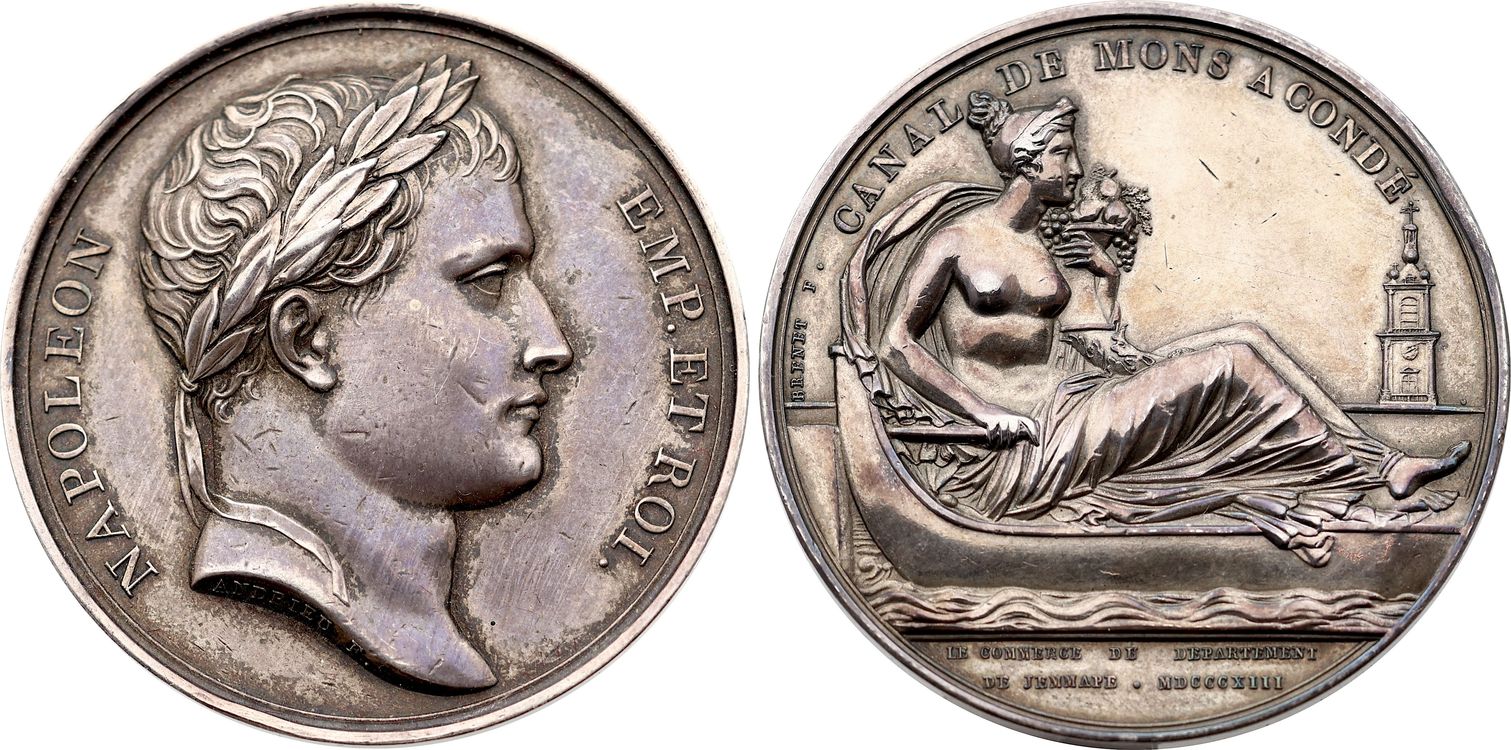
Lot 439
France. Napoleon I (1804-1814), Canal de Mons à Condé (1813), Brenet (Silver, 38.69 gr, 40.50 mm). Julius 2737. Extremely Fine, traces of old cleaning, minor edge nick.
The Canal de Mons à Condé was a significant infrastructure project during the reign of Napoleon Bonaparte, designed to improve transportation and enhance military logistics. Spanning between Mons in present-day Belgium and Condé-sur-l'Escaut in northern France, the canal was part of Napoleon's broader efforts to modernize France and its empire, particularly its military capabilities.
The canal was envisioned as a way to link the Sambre and Escaut rivers, facilitating the movement of goods and troops between France and the regions of the Low Countries. Napoleon recognized the strategic importance of such waterways, both for economic development and for ensuring military mobility during the Napoleonic Wars. The canal would provide a reliable route for transporting supplies, troops, and artillery, essential for the movement of French forces across northern Europe.
Construction of the Canal de Mons à Condé began in 1804, but it was not completed until after Napoleon's fall from power. While the canal's completion did not fully match Napoleon's grand vision due to political and financial challenges, it remained an important regional transportation route throughout the 19th and early 20th centuries.
Napoleon's push for projects like the Canal de Mons à Condé reflected his broader ambitions to improve France's infrastructure, strengthen its economy, and ensure military dominance. Though not as widely known as his military campaigns, the canal exemplified his strategic foresight in infrastructure development.
Your bid will be submitted to Auction Winter 2024. The auctioneer reserves the right to accept or reject your bid. If you do not have prior standing with Auction Winter 2024, please contact us for verification.